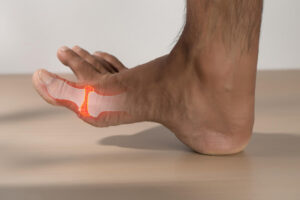
Spring ligament insufficiency happens when the band of tissue supporting your inner arch stretches or tears, often alongside posterior tibial tendon problems. The result is a collapsing arch, inner foot pain, and difficulty walking normally. A podiatrist can diagnose the condition with a physical exam and imaging, then guide you toward bracing, therapy, or surgical repair depending on severity.
Your inner arch has been aching for weeks, and it is not getting better on its own. Maybe you noticed your foot looks flatter than it used to. Maybe standing for long periods now leaves you in real pain. These are common signs of spring ligament insufficiency, a condition where the ligament holding up your arch stretches beyond what it can recover from.
This guide walks you through what causes spring ligament insufficiency, the symptoms that set it apart from ordinary foot pain, and how a podiatrist diagnoses and treats it. If your arch support feels like it is giving out, you deserve clear answers and a path forward.
What Causes Spring Ligament Insufficiency
The spring ligament stretches beneath your foot, connecting two bones and holding up the arch during every step you take. When this ligament is overstretched or strained repeatedly, it loses its ability to spring back into shape. Over time, this leads to a sagging arch and ongoing instability.
Common Triggers
- Posterior tibial tendon dysfunction: Damage to this nearby tendon often places extra strain on the spring ligament, speeding up its breakdown.
- Repetitive impact: Running, dancing, or standing for long hours can wear down the ligament gradually.
- Previous foot injuries: A prior sprain or fracture can leave the ligament weaker and more vulnerable to future stress.
- Obesity or sudden weight gain: Added pressure on the arch increases strain on the ligament with every step.
Understanding these triggers helps explain why this condition often develops slowly, long before the pain becomes impossible to ignore.
Signs and Symptoms: When Inner Arch Support Stretches Beyond Recovery
Inner foot pain is easy to brush off as everyday soreness. But when your arch begins to flatten and the ache does not improve, you may be dealing with spring ligament insufficiency rather than simple fatigue.
Symptoms to Recognize
- Pain along the inner arch: Discomfort that worsens with standing, walking, or physical activity.
- Visible flattening of the foot: A noticeably lower arch compared to before.
- Swelling near the inner ankle: Mild to moderate swelling along the ligament’s path.
- Difficulty with balance: A feeling of instability, especially on uneven ground.
If you notice these symptoms persisting for more than a few weeks, it is time to have your foot evaluated by a podiatrist.
How Is Spring Ligament Insufficiency Diagnosed and Treated?
A podiatrist typically starts with a physical exam, checking your arch alignment and testing for tenderness along the ligament. Because the spring ligament can be hard to assess with a standard X-ray, your podiatrist may order an MRI to get a full picture of the damage.
Treatment Options
- Bracing and orthotics: Custom supports can relieve pressure on the arch and slow further stretching.
- Physical therapy: Targeted exercises strengthen the surrounding muscles and improve stability.
- Anti-inflammatory care: Medication and icing help manage pain and swelling during recovery.
- Surgical repair: For significant tears, your podiatrist may recommend surgery to reconstruct the ligament and restore arch support.
Choose conservative care if your arch collapse is mild and your symptoms respond to bracing and therapy. Choose surgical repair if your pain continues despite treatment, or if imaging shows the ligament has torn significantly.
You Deserve Answers, Not Guesswork
Living with a collapsing arch is frustrating, especially when the pain keeps interrupting your daily life. You do not have to figure this out on your own.
Our podiatry team is here to give you an accurate diagnosis and a treatment plan built around your needs. Whether you need custom orthotics, physical therapy, or a conversation about surgical options, our podiatrist will explain every step clearly. Reach out to us today by calling +1-718-367-2555 or visiting us at 1797 Pitkin Avenue, Brooklyn, NY 1121 to schedule an evaluation and start treating spring ligament insufficiency before it affects your mobility any further.