Exercise stress echocardiography lets your cardiologist watch your heart in action, not just at rest. By tracking valve regurgitation and wall motion under strain, this test reveals problems that only show up when your heart is working hard, giving your care team a clearer picture than a standard echocardiogram alone.
Resting tests do not always tell the whole story. You may feel short of breath climbing stairs or notice your chest tighten during a walk, yet a standard echocardiogram at rest comes back looking normal. That gap between how you feel and what the scan shows can leave you without answers.
Exercise stress echocardiography was designed to close that gap. It gives your cardiologist a way to see your heart working under real physical demand, so nothing important gets missed.
What Is Exercise Stress Echocardiography?
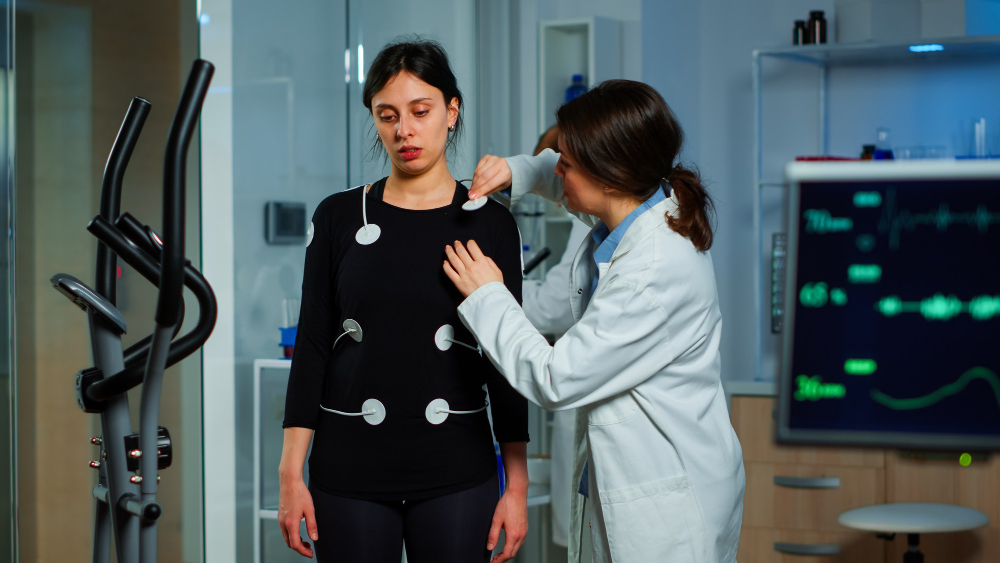
Exercise stress echocardiography is a noninvasive test that combines ultrasound imaging with physical exertion, usually on a treadmill or stationary bike. It allows your cardiologist to compare how your heart looks and functions at rest versus during activity.
How the Test Works
You will walk or pedal at increasing intensity while a technician monitors your heart rate, blood pressure, and symptoms. Ultrasound images are taken before and immediately after exertion.
- Noninvasive and safe: No incisions or sedation are needed, and most patients return to normal activity the same day.
- Closely supervised: A medical team watches you throughout, ready to stop the test if you feel unwell.
- Real-world insight: Because your heart is imaged under physical stress, the results reflect what actually happens during everyday activity, not just while lying still.
Tracking Valve Regurgitation and Wall Motion Under Strain
Some heart conditions only reveal themselves when your heart is asked to work harder. Tracking valve regurgitation and wall motion under strain helps your cardiologist catch issues that a resting scan can miss entirely.
What Valve Regurgitation Reveals
Valve regurgitation happens when a heart valve does not close properly, letting blood leak backward instead of moving forward efficiently. During exertion, this leakage can become more pronounced, making it easier to detect and measure accurately.
What Wall Motion Reveals
Your heart’s walls should contract evenly with every beat. When part of the heart muscle is not receiving enough blood flow, that section may move weakly or abnormally during exercise, even if it looks fine at rest. Tracking valve regurgitation and wall motion under strain together gives your cardiologist a fuller view of how your heart truly performs when it matters most.
How Your Cardiologist Uses the Results
Your cardiologist combines these findings with your symptoms and medical history to build a plan that fits your life.
- Confirms or rules out disease: Clear imaging helps distinguish between normal exertion symptoms and an underlying heart condition.
- Guides treatment decisions: Results can inform medication changes, lifestyle recommendations, or the need for further testing.
- Tracks changes over time: Repeat testing lets your cardiologist monitor whether a known condition is stable, improving, or progressing.
Choosing a Cardiology Clinic in Brooklyn
Finding a cardiology clinic in Brooklyn close to home makes ongoing monitoring far easier to manage, especially if you need repeat testing or follow-up visits. A cardiology clinic in Brooklyn familiar with your neighborhood can also coordinate smoothly with your primary care provider, so nothing falls through the cracks.
You Deserve a Clear Picture of Your Heart Health
Unexplained symptoms during activity are unsettling, and they deserve real answers. Exercise stress echocardiography gives you and your cardiologist a window into how your heart truly performs under strain, not just a snapshot of it resting quietly. Our Cardiology team connects patients with experienced cardiologists who explain every result clearly and build a plan around your specific needs. Reach out to us today by calling +1-718-367-2555 or visiting us at 1797 Pitkin Avenue, Brooklyn, NY 1121 to talk about what your heart needs.