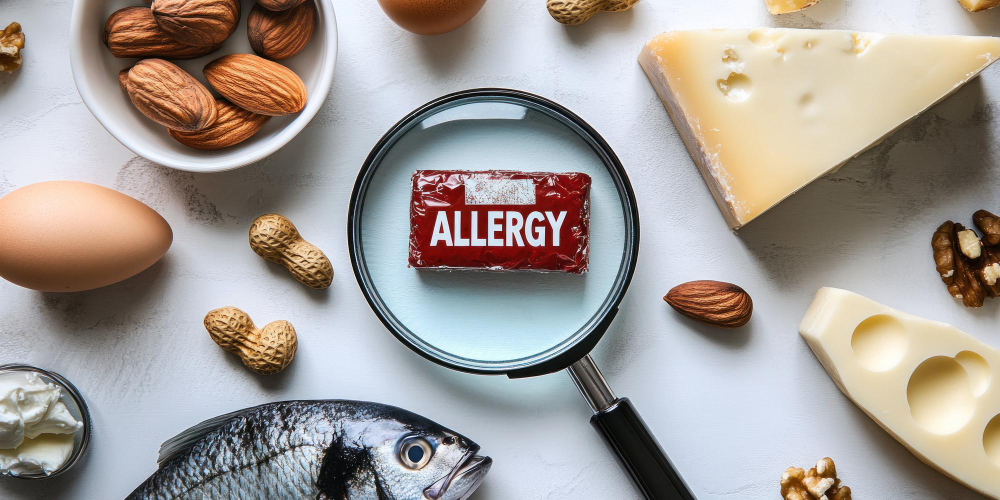
Living with a food allergy, or cooking for someone who does, turns every trip to the grocery store into a high-stakes detective mission. In the United States, grocery shopping got slightly more complex but significantly safer when sesame officially joined the ranks of major food allergens, transforming the traditional “Big Eight” into the “Big Nine.”
By law, the U.S. Food and Drug Administration (FDA) requires food manufacturers to explicitly list these major allergens. However, hidden ingredients, complex scientific terminology, and voluntary advisory statements can still leave shoppers feeling uncertain.
This practical guide will help you decode food labels with confidence, identify hidden ingredients, and navigate the grocery aisles safely.
Meet the “Big Nine”
The Big Nine represent the food groups responsible for more than 90% of all serious food allergic reactions in the United States.
- Milk
- Eggs
- Peanuts
- Tree Nuts
- Wheat
- Soy
- Fish
- Crustacean Shellfish
- Sesame
Under the Food Allergen Labeling and Consumer Protection Act (FALCPA) and the FASTER Act, manufacturers must declare the presence of these specific nine allergens in plain English.
How Allergens Are Declared on Labels
Food manufacturers generally use one of two formats to declare major allergens on the ingredient list. Train your eyes to look for both styles:
1. The “Contains” Statement
This is the most visible method. A separate summary line is placed immediately below or adjacent to the ingredient list.
- Example: “Ingredients: Enriched flour, sugar, natural flavor. Contains: Wheat.“
2. Parenthetical Declarations
The allergen is listed in parentheses directly within the ingredient list itself, immediately following the ingredient’s technical name.
- Example: “Ingredients: Whey (milk), lecithin (soy), flour (wheat).”
The Hidden Aliases: Spotting Cryptic Terminology
While major allergens must be declared in plain English, cross-contamination or secondary ingredients can sometimes mask their presence if you are reading non-regulated items or international foods.
Furthermore, variations within an allergen category—like tree nuts or fish—require you to look for specific species. Memorize these common hidden aliases:
Major Allergen | Common Hidden Aliases & Technical Names |
Milk | Casein, whey, curds, ghee, nougat, lactalbumin, hydrolysates |
Egg | Albumin, globulin, lecithin (egg-derived), lysozyme, ovalbumin, meringue |
Wheat | Spelt, kamut, farro, durum, semolina, einkorn, bulgur, seitan |
Soy | Edamame, miso, natto, shoyu, tamari, tempeh, textured vegetable protein (TVP) |
Sesame | Tahini, benne seed, gomasio, halvah, sesamol, til |
Tree Nuts | Must specify the exact nut (e.g., Almond, Walnut, Cashew, Pecan, Coconut) |
Fish / Shellfish | Must specify the exact species (e.g., Cod, Salmon, Tuna / Crab, Lobster, Shrimp) |
Decoding Advisory Statements: “May Contain” vs. “Made In”
You have likely noticed various voluntary statements on packaging, such as:
- “May contain peanuts.”
- “Processed in a facility that also processes wheat.”
- “Manufactured on shared equipment with milk.”
CRITICAL SAFETY RULE:
- The FDA does NOT regulate advisory statements.
- “May contain” carries the exact same cross-contamination risk
- as “Manufactured on shared equipment.” Treat them with equal caution.
These are called Precautionary Allergen Labeling (PAL) statements. Manufacturers use them voluntarily to warn consumers about the risk of accidental cross-contamination during manufacturing. Because these statements are not strictly standardized, clinical experts recommend that individuals with severe, life-threatening allergies avoid products carrying any of these warnings.
3 Golden Rules for Safe Grocery Shopping
To keep your kitchen completely safe, adopt these three systematic shopping habits:
1. Use the “Rule of Three”
An allergen recipe or manufacturing process can change without warning. Check the label three distinct times:
- At the store before placing the item in your cart.
- At home while putting the groceries away.
- Right before cooking or serving the food item.
2. Beware of “Allergen-Free” Lookalikes
Do not rely solely on front-of-package marketing buzzwords like “plant-based,” “vegan,” or “healthy.” A “vegan” cookie is completely dairy-free and egg-free, but it could still be packed with wheat, soy, tree nuts, or sesame. Always flip the package over to read the official mandate label.
3. Contact the Manufacturer Directly
If an ingredient list contains vague terms like “natural flavors,” “spices,” or “enzyme,” and does not have a “Contains” statement, don’t guess. If you are highly sensitive, call the customer service number on the back of the package to confirm the exact source of those proprietary flavor blends.
Stay Safe, Stay Informed
Mastering the language of food labels is the ultimate tool for reclaiming control over your diet. By understanding how the Big Nine are declared, identifying hidden ingredients, and respecting precautionary warnings, you can navigate the grocery store with complete confidence and peace of mind.
Reach out to our allergist team today to book an Allergy consultation by calling +1-347-384-5690 or visit our clinic at 1797 Pitkin Avenue, Brooklyn, NY 11212 to help you manage your allergies.