Standing desks can worsen venous insufficiency by reducing calf muscle movement, which is essential for pushing blood back up toward the heart. Stopping standing desk leg pain caused by venous insufficiency requires targeted movement, compression support, and — when symptoms persist — evaluation by a vascular specialist.
Standing desks were supposed to be the solution. Less sitting, better posture, more energy. But for many people, swapping a chair for a standing position has introduced a different problem: heavy, aching legs that get worse as the day goes on. If that sounds familiar, venous insufficiency may be what is driving your discomfort. Understanding why this happens — and what you can do about it — is the first step toward real relief.
What Is Venous Insufficiency, and Why Does Standing Make It Worse?
How venous insufficiency affects circulation in your legs
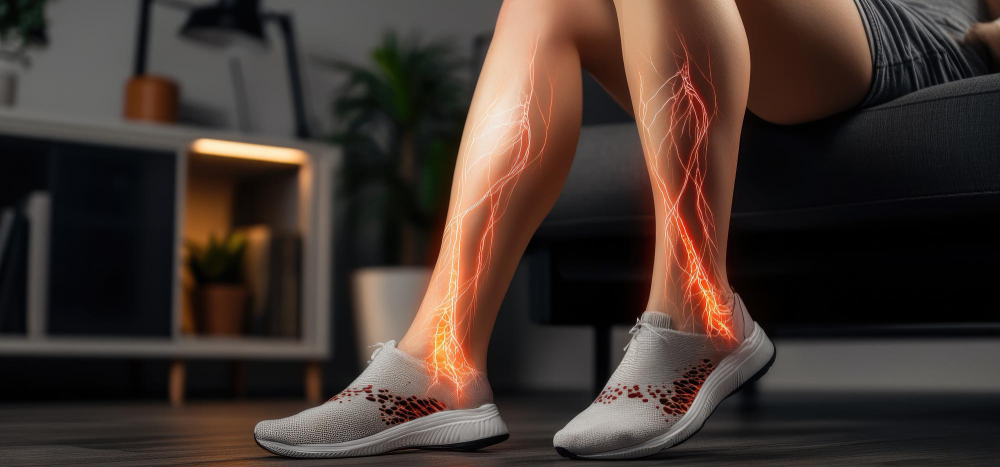
Veins carry blood from your legs back up to your heart. To do that against gravity, they rely on one-way valves that open and close with each muscle contraction. Venous insufficiency occurs when those valves weaken or fail, allowing blood to pool in the lower legs instead of flowing upward.
The result is pressure. That pressure causes swelling, aching, a sensation of heaviness, and sometimes visible varicose veins. According to the Society for Vascular Surgery, venous insufficiency affects an estimated 40% of people in the United States — making it far more common than most people realize.
Why standing desks can aggravate venous insufficiency symptoms
Standing still is not the same as moving. When you stand without shifting weight, contracting your calves, or walking, the muscle pump that supports venous return essentially stops working. Blood collects in the legs, pressure builds in the veins, and the aching begins.
Prolonged static standing can be just as hard on your circulation as prolonged sitting — sometimes worse, particularly if you already have compromised vein function.
How to Relieve Standing Desk Leg Pain Caused by Venous Insufficiency
Movement strategies that support vein function throughout the day
Small, deliberate movements make a meaningful difference. You do not need to leave your desk — you just need to keep your calf muscles active.
- Calf raises: Rise onto your toes and lower back down slowly. Do 10–15 repetitions every 30 minutes to activate the muscle pump.
- Weight shifts: Alternate between resting your weight on one leg, then the other. This encourages circulation without interrupting your work.
- Anti-fatigue mats: Standing on a cushioned mat encourages subtle postural adjustments that keep blood moving.
- Scheduled breaks: Set a timer to walk for two to three minutes every hour. Even short walks significantly reduce venous pressure.
Using compression to counteract venous pooling
Graduated compression stockings apply gentle, consistent pressure to the lower legs, helping veins push blood upward. According to the American Venous Forum, compression therapy is one of the most evidence-based interventions for venous insufficiency symptoms. Talk to your doctor about the appropriate compression level before purchasing — the wrong grade can be uncomfortable or ineffective.
Adjusting your workspace to reduce leg strain
Your desk height matters. If your standing position causes you to lock your knees or hunch your hips, it adds unnecessary strain. Aim for a setup where your elbows rest at roughly 90 degrees and your weight is distributed evenly across both feet.
Alternating between sitting and standing every 30 to 60 minutes is more beneficial than committing to one posture for hours at a stretch.
When Standing Desk Leg Pain Requires Professional Evaluation
Movement strategies and compression help manage symptoms, but they do not treat the underlying vein damage. If your leg pain is persistent, accompanied by swelling that does not resolve overnight, skin changes near the ankle, or visible varicose veins that are getting worse, those are signs that your veins need a proper evaluation.
Venous insufficiency is a progressive condition. The earlier it is identified, the more options are available — and the easier it is to slow its progression.
Find Relief Through Our Department
You deserve to stand at your desk without pain. If stopping standing desk leg pain has proven difficult despite your best efforts, the problem may be deeper than posture or routine.
Our Vascular team specializes in vascular care and can assess whether venous insufficiency is driving your discomfort. We offer personalized treatment plans that address both symptoms and their root cause. Reach out today by calling 1-347-384-5690 or visiting us at 1797 Pitkin Avenue, Brooklyn, New York 11212 to schedule your evaluation and take the first step toward lasting relief.