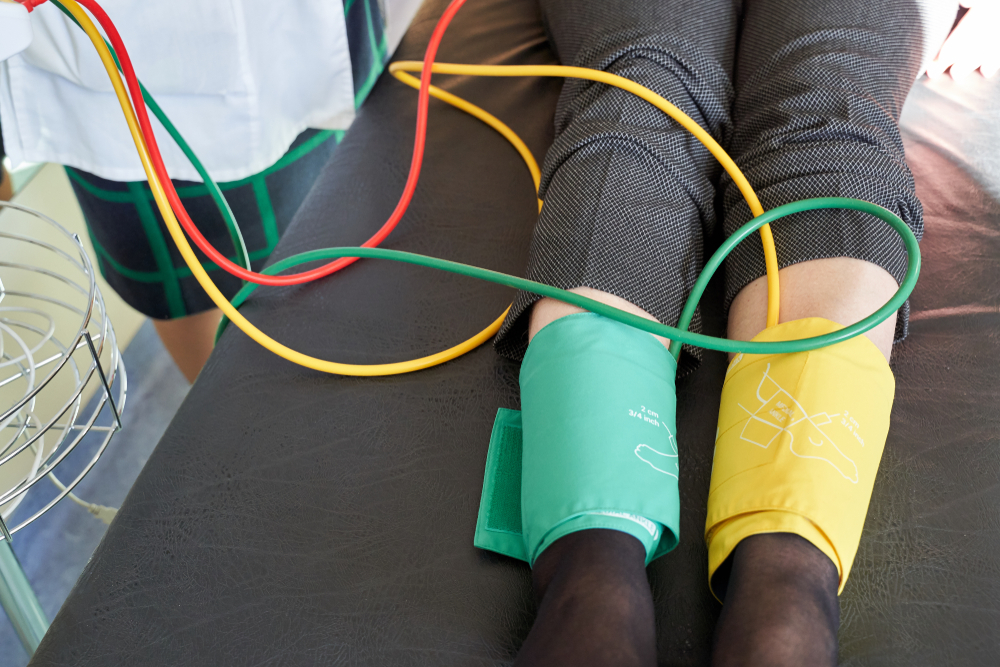
The ankle-brachial index compares blood pressure in your ankle to blood pressure in your arm, revealing how well blood is flowing through your leg arteries. A low ratio often signals peripheral artery disease. A vascular specialist uses this simple, painless test to catch circulation problems early, often before serious symptoms appear.
If your legs cramp when you walk, or you have noticed wounds on your feet that are slow to heal, you may be dealing with more than tired muscles or dry skin. These are common signs that blood is not reaching your legs the way it should. The ankle-brachial index, often shortened to ABI, is one of the simplest tools doctors use to check for this problem, and it can bring real clarity to symptoms that have felt confusing or worrying.
This guide explains what the ankle-brachial index measures, how your results are interpreted, and when it makes sense to talk with a vascular specialist.
What Is the Ankle-Brachial Index?
The ankle-brachial index is a quick, non-invasive test that compares the blood pressure in your ankle to the blood pressure in your arm. Healthy arteries carry blood efficiently from your heart down to your feet. When arteries narrow due to plaque buildup, a condition called peripheral artery disease, blood pressure in the ankle drops relative to the arm.
A technician measures blood pressure at both locations using a standard blood pressure cuff and a handheld Doppler device. The two readings are then compared to produce a ratio, which becomes your ankle-brachial index score.
Decoding Pressure Ratios for Arterial Health
Your ankle-brachial index score tells a clear story about how well blood is moving through your legs. Generally, a ratio between 1.0 and 1.4 is considered normal. A score below 0.9 suggests some degree of peripheral artery disease, while a score below 0.5 often points to more severe blockage that needs prompt attention.
How a Vascular Specialist Interprets ABI Results
A vascular specialist looks at your ankle-brachial index alongside your symptoms, medical history, and lifestyle factors, including:
- Severity of the ratio: A mildly low score may call for lifestyle changes and monitoring, while a very low score often requires more direct treatment.
- Your symptoms: Leg pain during walking, numbness, or slow-healing wounds help a vascular specialist understand the full impact on your daily life.
- Risk factors: Diabetes, smoking history, and high blood pressure all shape the recommended next steps.
Choose lifestyle adjustments and regular monitoring if your ratio is only mildly low and your symptoms are manageable. Choose a more targeted intervention if your score points to significant blockage or your symptoms are worsening.
When Should You See a Vascular Specialist?
You do not need to wait for severe pain before seeking answers. Early evaluation often leads to simpler, less invasive treatment. Consider reaching out if you or your loved one notice:
- Leg pain or cramping that starts during walking and eases with rest
- Wounds or sores on the feet that heal slowly or not at all
- Cold or discolored skin on the lower legs or feet
Getting Answers Close to Home
You should not have to guess what an unusual ankle-brachial index score means for you or a loved one. A vascular clinic in Brooklyn can review your results, explain exactly what they show, and build a care plan suited to your specific health needs.
Our Vascular team works closely with patients and families to turn test results into a clear, manageable path forward. If you or a loved one are dealing with leg pain, slow-healing wounds, or circulation concerns, reach out to us today by calling +1-718-367-2555 or visiting us at 1797 Pitkin Avenue, Brooklyn, NY 1121 to schedule a consultation.