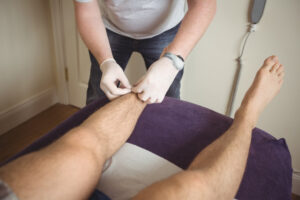
Yes, overpronation and flat feet can cause chronic knee strain. When your feet roll inward too much while walking or running, the misalignment travels upward, placing extra stress on your knees, hips, and lower back. Over time, this repeated strain can lead to persistent pain and joint irritation. A podiatrist can assess your foot structure and recommend orthotics, footwear changes, or targeted exercises to correct the imbalance and relieve pressure on your knees.
Knee pain that will not go away can feel confusing, especially when there was no clear injury to explain it. You may have tried rest, ice, or over-the-counter pain relievers, only to find the ache creeps back the moment you get back on your feet. If this sounds familiar, the source of your discomfort might not be your knee at all. It could be starting much lower, in the way your feet strike the ground.
Do overpronation and flat feet cause chronic knee strain? For many people, the answer is yes. Understanding the connection between your foot structure and your knee health is the first step toward lasting relief.
What Is Overpronation and How Does It Affect Your Knees?
Overpronation happens when your foot rolls too far inward each time it hits the ground. A small amount of pronation is normal and helps absorb shock as you walk or run. Overpronation goes beyond that natural motion, placing extra twisting force on your ankles, shins, and knees with every step.
This inward roll changes how your leg aligns from the ground up. Your shinbone rotates inward, and your knee is pulled slightly out of its natural tracking path. Repeated over thousands of steps a day, this misalignment adds up to real, lasting strain.
How Flat Feet Contribute to Knee Strain
Flat feet and overpronation often go hand in hand. Without a proper arch to support and distribute your body weight, your foot has little choice but to roll inward for stability. This puts additional pressure on the inside of your knee joint.
Over time, that added pressure can contribute to conditions like patellofemoral pain syndrome or accelerated wear on your knee cartilage. Your knee was not designed to compensate for foot instability, so it often bears the cost.
Signs You May Be Dealing with Chronic Knee Strain from Foot Issues
You do not have to guess whether your feet are behind your knee pain. There are usually clear signs pointing to the connection. Watch for:
- Pain that worsens with activity: Discomfort that increases during walking, running, or standing for long periods.
- Uneven shoe wear: Excessive wear on the inside edge of your shoe soles.
- Visible arch collapse: Your arch appears flat or disappears entirely when you stand.
- Inner knee tenderness: Pain concentrated on the inside of one or both knees.
- Fatigue in your legs: A tired, achy feeling in your legs and feet by the end of the day.
If any of these sound familiar, your knee pain may be rooted in how your feet function.
How a Podiatrist Can Help
You do not need to manage this pain alone. A podiatrist can evaluate how you stand, walk, and move to determine whether overpronation or flat feet contribute to your knee strain. This kind of hands-on assessment offers clarity that guesswork simply cannot provide.
Diagnosis and Treatment Options
During your visit, a podiatrist will typically examine your foot structure, watch your gait, and may use imaging to rule out other causes of knee pain. From there, treatment is built around your specific needs.
Common treatment options include:
- Custom orthotics: Supportive inserts that correct pronation and restore proper alignment.
- Targeted footwear guidance: Recommendations for shoes that support your arch and stabilize your stride.
- Physical therapy: Exercises that strengthen the muscles supporting your foot and knee.
- Ongoing monitoring: Follow-up care to track improvement and adjust your plan as needed.
Every treatment plan should reflect your body, your activity level, and your goals, not a generic fix.
Relief Starts With Understanding the Root Cause
Chronic knee pain does not have to be something you simply live with. Once you understand that overpronation and flat feet may be driving your discomfort, you can take real steps toward relief.
A podiatrist can help you get answers and a personalized plan, so you can move through your day with less pain and more confidence. Reach out to our podiatry team today by calling +1-718-367-2555 or visiting us at 1797 Pitkin Avenue, Brooklyn, NY 1121 to schedule an evaluation and take the first step toward stronger, more stable knees.